article Escher, M.C. This article is a great introduction to the work of M.C. Escher. Students love his work and will also enjoy learning more about his life. Students will be able to gain some relevant biographical information from this article. This biography page comes from Scholastic, which also features a number of other artist biographies. Each is a brief overview of the artist, written for younger readers. Students should have little difficulty with the language presented.
This would be a good place for students to start with researchingEscher, or they could use this site to research the artist of their choice. Jecman, G. D. (n.d.). Escher, m.c. Scholastic ART, Retrieved from http://www.scholastic.com/browse/article.jsp?id=3754395 website Edward Hopper - Whitney for Kids
Edward Hopper is an artist that students might not be familiar with, although many will recognize his most famous work, "Nighthawks." The Whitney for Kids site features a number of artists, including Hopper, in a format that is appealing to young audiences. The site is laid out in a pleasing fashion, with bright colors, pictures and text boxes. There are links to definitions of difficult words in the entries for each artist. Students will gain insight into the style and personality of this artist, as they explore his works.
The Whitney for Kids site will be one that I highly recommend to students as they complete the computer portion of their research.
Students love Maurice Sendak's books, and they will love this video of him. This is a longer video at around ten minutes, but it is very engaging. Sendak has a great deal to say about his own childhood and his work. Students will like the style of this video. It features interview clips of Sendak, interspersed with photos of him as a child and images of his work. This video will give students an understanding of Sendak's personality and artistic style.
This will be another supplemental resource for students working on the computer or at-home portion of their artist project.
(n.d.). Retrieved from http://www.youtube.com/watch?v=mZTQib7G2Hs
book Picasso (Getting to Know the World's Greatest Artists) From author Mike Venizia comes another of the "Getting to know the
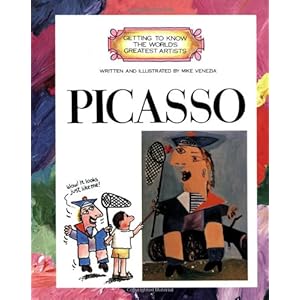
world's great artists" series. This book tells the s tory of Pablo
Picasso, arguably the most famous artist of the 20th century. Students
will enjoy Venezia's writing style. This will be an independent read for
most 7th graders, but the book is still loaded with facts, biographical
information, and information about Picasso's style. Particularly the
book explains Cubism with clear language which is helpful, as it is a
difficult concept for art students.
This book will be helpful as a research tool for students while completing their artist study.
Venezia, M. (1999). Picasso. New York: Grolier Publishing.
A great website! Artists for Teens This is a wonderful resource site for students beginning their research on an artist. It features links to several different reputable pages that will give students a wealth of information about artists. Of particular note are the links to the various gallery pages, and also the databases of artist information.Students will be able to begin here and follow links to find the information needed for their research. The page layout is not terribly interesting but it does have some nice links to games and other resources. Of particular note are the individual artist pages as well as the PBS link. I
will recommend this site to the computer teacher to make available to
the students when they come to the lab. Also I may be able to use the
projector and visit this site with an entire class sometime. I may take a
class period to show students all the available information they can
access by using this site as a starting point. Art history for teens. (n.d.). Retrieved from http://kids.usa.gov/teens-home/art/art-history/index.shtml
This book is terrific: Henri Rousseau This book is from the Getting to Know the World's Greatest Artists series. Author and illustrator Mike Venezia writes in simple language that even many young students would understand and enjoy. This book gives an excellent overview of the life of Henri Rousseau, including some information about his childhood.The language is plain enough for younger students to understand. Students always enjoy learning about this artist and his jungle paintings. Numerous reproductions of Rousseau's paintings are included in this book, along with descriptions of the works. Students will enjoy the comic-style illustrations as well.
For the artist biography project I will be making this and several other books from this series available to students to use as a resource for their project. Additionally I teach a unit to 5th grade about Rousseau and I believe this book would be appropriate for them as well.
Venezia, M. (2002). Henri rousseau. New York, NY: Scholastic.
A good video:
Andy Warhol This is a quick but very informative little video about the life of Andy Warhol. Famous for his influence in the Pop Art movement, Warhol is an artist that many students are not necessarily aware of but whose style they would likely enjoy. From this video students will learn about Warhol's childhood in Pittsburgh, as well as his rise to fame in New York, and finally his super-stardom throughout the remainder of his life. Several of Warhol's works are shown in this interview-style documentary. It presents the information in a way that will be interesting to students. They may discover that they have known about Warhol's works without realizing it.
This will be another video that I provide to my students who would choose Warhol as the artist that they want to study. It is a great overview of the artist and would be a good starting point for their research. (2012). Andy warhol. (2012). [Web Video]. Retrieved from http://www.youtube.com/watch?v=oPIEcihvDBw
Here is another article: Q & A With Tim Burton Students love Tim Burton movies, and they will enjoy this interview article from Scholastic News. The interview goes into details about Burton's childhood and adolescence. He discusses his life in middle school, who his inspirations were (teachers!), and also how he came to find his personal style. This article is nicely written in a way that students will understand and the questions are such that they will really relate to Burton and find some similarites in their own lives. I know I did! Students will enjoy reading this article if we work on a project about animation. The last time I taught an artist biography project, a student approached me and asked if she could do her report on Tim Burton. I was delighted with her request, and her subsequent report, so I am adding him to the list of choices.
Welty, T. (2012). Q & a withTim Burton. Scholastic News, Retrieved from http://www.scholastic.com/browse/article.jsp?id=3757576
This video is short but very fun. It is a five-minute video of Calder himself working with his sculptures, or as some would say, playing. Students will see a performance of Calder's "Circus," a collection of wire and metal sculptures made by Calder, that were almost like puppets. Every year my 6th graders learn about Calder. We watch an hour-long video and make a mobile in his style. One of the favorite parts of the video we watch is the small section that touches on the circus works. Students will love getting to see the complete production here. Students who choose Calder as their artist would get to reference this video in creating their imitation work for class. One important thing they will learn watching this video is that Calder's wire sculptures were meant to be played with or move in some way. Students will get a chance to view this video as 6th graders this year, perhaps, when I teach the Calder lesson in the spring. 7th graders, if they choose Calder, will be encouraged to watch this video during their computer class time or on their own at home. They'll enjoy seeing the circus in action and it will hopefully inform their work on the artist project. Whitney Museum. (2008, October 23). Alexander Calder performs his "Circus" - Whitney Museum [video file]. Retrieved from http://youtu.be/t6jwnu8Izy0 Check out this website: Artcyclopedia.com This website has an incredible amount of information that is well-organized and suited to all ages. Students will love the easy access to a wide variety of information about art history. Searchable by artist and title, as well as by art museum, this site is a resource for anyone looking to learn basic information about artists and their works. Students can look up the name of their chosen artist and view a number of his or her works. Short descriptions are included on every page, about the particular work and the artist's life. Additionally students will find a section titled "Art Movements" which gives brief overviews of various styles and periods in art history. This is a great resource for art students of all levels. All of the 7th grade students will be encouraged to view this site to gain information for their artist project. They will be able to find answers to fill in their artist info worksheets as well as view the works of those artists. They may even gain some insight into the works themselves.
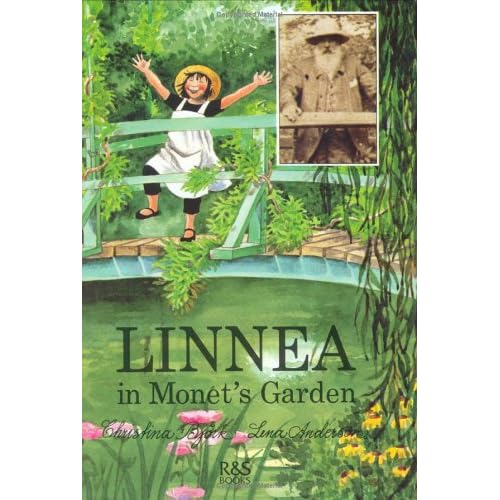
(http://www.artcyclopedia.com) You might like this book: Linnea in Monet's Garden This book is written from the point-of-view of Linnea, a young girl who goes to Paris on vacation. While there, she visits Monet's garden and learns about Monet as well as about Impressionist art. It includes colorful illustrations and a "scrapbook" look. Reproductions of his work are included as well as photos of the original source locations. It will help students to connect his style to what the places really looked like. Through this, they will gain an understanding of the Impressionist movement. This will be a quick read for older students but it has lovely illustrations and gives good information in a unique way. Students will enjoy the first-person perspective and gain an understanding about Monet through the eyes of the character Linnea. I have a copy of this book in my classroom for any student who wishes to read it. If I were to teach a lesson on Monet I would probably like to read selections of this book to my class. Any 7th grader choosing Monet as his or her artist for this unit would be encouraged to read this book independently to get some information for their artist project. Bjork, C., & Anderson, L. (1992). Linnea in Monet's Garden. (6th Printing ed.). New York: Farrar, Strauss and Giroux. This article is interesting: A Mural's Story This article tells of a mural that was painted by artist Maurice Sendak. Sendak is most famous for Where the Wild Things Are, but this mural was completed two years before then. Students will enjoy learning a little about an artist and author who is both well-known and well-loved. Also included on this page is a video of Sendak himself. Sendak is most well-known for being an author but he also illustrated his work. Students choosing Sendak as their artist of choice will be encouraged to read many of Sendak's books to gain an understanding of his artistic style. This article is a way for them to see beyond what Sendak is known for, books, to realize that he was also an artist in his own right. I would encourage students to read this article together before we began a project on "Wild Things", a project that I like to do in the fall for Halloween. Any 7th grader who chooses Maurice Sendak as an artist to study for class would be given a link to this article to read on their own during computer time, so they could also view the supporting materials and complete their research.
Retrieved from http://www.timeforkids.com/news/mural’s-story/10866